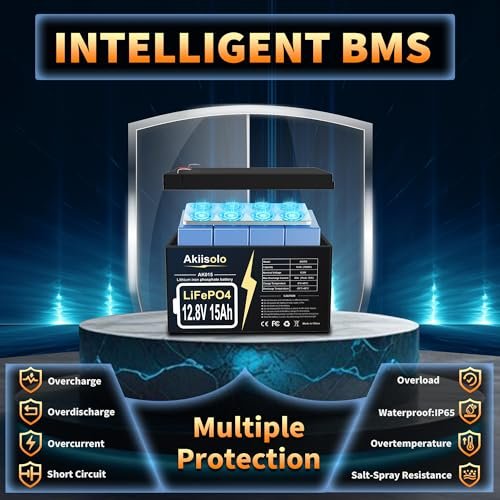
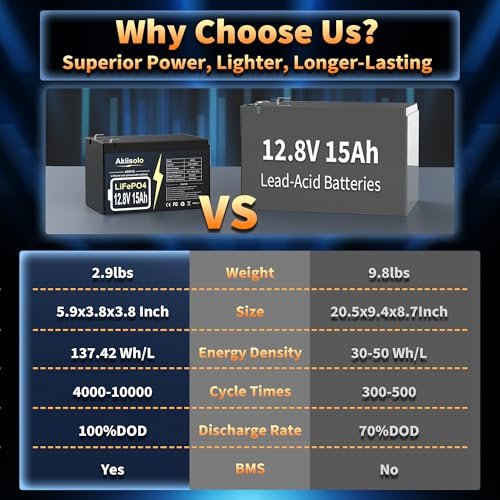
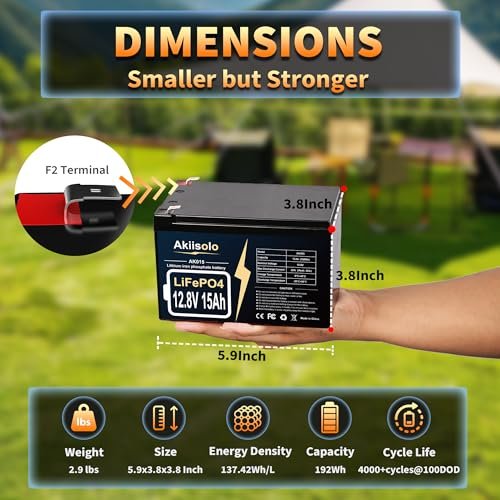
Akiisolo's lithium iron phosphate batteries are rated to 2,000+ full cycles at 100% depth of discharge — roughly 5 to 10 years of real-world use depending on how often you cycle them. The 15Ah pack weighs just 3 lbs; the 100Ah comes in at 21.8 lbs — both significantly lighter than equivalent AGM units. Every pack includes a built-in BMS that cuts power automatically if voltage, current, or temperature goes outside safe limits, so the battery protects itself when conditions get rough. Check current pricing on Amazon to see both models.
Both Akiisolo models are rated to 2,000+ cycles at 100% DOD — roughly 4 times the cycle life of a comparable AGM battery under the same conditions.
The 100Ah unit's built-in BMS handles 100A continuous discharge with protection against overvoltage, over-discharge, overcurrent, and short circuits.
The 15Ah pack weighs 3 lbs; the 100Ah comes in at 21.8 lbs — compared to 50–60 lbs for an equivalent AGM, that's a difference you feel on installation day.
Both batteries support up to 4S series and 4P parallel configurations, so you can expand capacity or voltage later without replacing existing hardware or mismatching chemistry.
Two models, two capacity tiers — the compact 15Ah for portable and small-draw applications, and the 100Ah deep-cycle unit for RV, solar, and marine systems that need hours of sustained runtime. The right choice comes down to what you're powering and how long you need it to run.
At 3 lbs and 192Wh of usable energy, the AK015 is built for applications where weight is a real constraint — fish finders, mobility scooters, ride-on toys, and portable lighting. It ships with a compatible LiFePO4 charger included, which is not the case with the 100Ah model.
The only Akiisolo battery that comes with a charger in the box — if you're starting fresh without an LFP-compatible charger, this matters immediately.
See on Amazon
The AK100 delivers 1,280Wh from a 21.8 lb pack with a 100A continuous BMS — enough headroom for RV house banks, trolling motors at mid-throttle, and off-grid solar storage. Charger not included; you'll need a LiFePO4-profile charger rated for your charge current before first use.
At 21.8 lbs with 4S/4P expansion support, this is the battery to start a scalable 12V or 24V system without committing to a premium-brand price point.
See on AmazonDiscover the full product lineup with current selection on Amazon.
All products on AmazonThe short answer: if you're powering something small and portable — a fish finder, a mobility scooter, kids' ride-on toys — the 15Ah Compact LiFePO4 with Charger is the right call. If you're running an RV house bank, a solar storage system, or a trolling motor for hours at a stretch, you need the 100Ah Deep Cycle LiFePO4 Battery. The two products don't really overlap.
Three pounds. That's the entire weight of the AK015. For a kayak angler mounting a battery to a bracket behind the seat, or someone swapping out the sealed lead-acid pack in a mobility scooter, that weight difference is immediately felt. At 192Wh (12.8V × 15Ah), this pack runs a mid-range fish finder drawing 15W for roughly 12.8 hours — more than enough for a full day on the water.
The included charger matters here. You don't need to source a LiFePO4-compatible charger separately, which is a real friction point for first-time LFP buyers who don't realize their old lead-acid charger won't work correctly.
One honest limitation: 192Wh runs out fast under heavier loads. A 12V RV refrigerator drawing 50W will exhaust this pack in under 4 hours. Don't size this battery for an application that calls for the 100Ah.
At 1,280Wh and 21.8 lbs, the AK100 is a different product for a different buyer. The 100A continuous BMS rating gives it enough headroom to handle a 12V trolling motor at mid-throttle (typically 30–50A draw) without nuisance cutoffs. Four of these wired in parallel gives you 400Ah — 5,120Wh — which is a functional small solar bank for a van or off-grid cabin.
No charger is included. Budget for a LiFePO4-profile charger rated to match your charge current needs — typically 20–50A for everyday cycling.
If you're still unsure which size fits your system, the runtime math in the next section will give you a concrete answer based on your actual device wattage.
Every LiFePO4 battery listing makes runtime sound better than it is. Here's the actual math: divide the battery's usable watt-hours by your device's wattage, and you get real hours. The AK015 holds 192Wh (12.8V × 15Ah). The AK100 holds 1,280Wh (12.8V × 100Ah). No rounding, no vague claims.
The formula is straightforward:
Runtime (hours) = Wh capacity ÷ Device wattage
For practical planning, apply an 80–90% usable depth of discharge rather than drawing the battery completely flat on every cycle. At 80% DOD, the AK015 delivers about 154Wh of working energy and the AK100 delivers about 1,024Wh. These are the numbers worth using when you're sizing a system.
All figures below use the full rated capacity (192Wh and 1,280Wh) at the device's typical draw. Real-world results vary based on throttle setting, inverter efficiency, and ambient temperature.
| Device | Typical Draw | AK015 (192Wh) | AK100 (1,280Wh) |
|---|---|---|---|
| Fish finder (mid-range) | 15W | ~12.8 hrs | ~85 hrs |
| LED light strip | 10W | ~19.2 hrs | ~128 hrs |
| 12V RV refrigerator | 50W | ~3.8 hrs | ~25.6 hrs |
| CPAP machine (12V direct) | 25W | ~7.7 hrs | ~51 hrs |
| 12V diesel heater (run mode) | 12W | ~16 hrs | ~107 hrs |
| Trolling motor (mid throttle) | ~480W (40A at 12V) | Not rated for this load | ~2.7 hrs |
The trolling motor row deserves a note. Mid-throttle draw on a 12V trolling motor typically runs 30–50A. At 40A, the AK100's 100A BMS handles it without complaint — but full-throttle operation can push well past 80A and should not be used as a planning baseline for runtime. Plan for mid-throttle, run at what the fish require.
A kayak angler running a Garmin Striker 4 (roughly 10W) all day from the AK015: 19+ hours of fish finder runtime on a single charge. In practice that's two full days on the water between charges.
An RV owner running a 12V compressor refrigerator (50W average) overnight from a single AK100: about 25 hours of runtime before the BMS low-voltage cutoff kicks in. That's a full overnight stay without solar input. Add a second AK100 in parallel and you're at 50+ hours of refrigerator runtime — enough for a long weekend without hookups.
One thing these numbers won't show: voltage sag. Lead-acid batteries lose voltage noticeably as they discharge, which causes fish finders and electronics to perform worse toward the end of a charge. LiFePO4's flat discharge curve holds close to 12.8V through roughly 95% of capacity. The fish finder running off the AK015 at hour 12 performs about the same as it did at hour 1.
The most common way buyers damage a LiFePO4 battery — including Akiisolo's — is using the wrong charger or charging it in cold weather. Both issues are avoidable. Here's what actually matters before you plug anything in.
LiFePO4 batteries require a charger programmed for the LFP charge profile: a charge voltage of 14.4–14.6V and a termination current that suits the chemistry. A standard lead-acid or AGM charger uses a different charge voltage and absorption phase — it won't fully charge an LFP pack and, in some cases, can damage cells over repeated cycles.
The AK015 ships with a compatible charger in the box. That's the right charger — use it. The AK100 does not include a charger. If you're buying the 100Ah unit, you need to source a LiFePO4-compatible charger rated for your target charge current before you run the first cycle. A 20–50A LFP charger is the right range for everyday home charging.
If you're charging from a solar charge controller or DC-to-DC charger in a vehicle, confirm the controller has an LFP or lithium battery profile setting. Setting it to AGM or flooded lead-acid will result in incorrect charge termination.
Akiisolo batteries ship at partial state of charge — typically 40–60% SOC — for transportation safety. A handful of buyers have reported units appearing non-functional on arrival. Almost always, the fix is simple: connect the correct charger and run a full charge cycle before first use.
Don't conclude the battery is defective until you've completed a full first charge. The BMS may show a low-voltage lockout when the pack arrives below a certain threshold, and the charger will reset this condition during the initial charge cycle.
Charging a LiFePO4 cell below freezing (32°F / 0°C) causes lithium plating on the anode — a form of permanent, irreversible cell damage that reduces capacity and shortens cycle life. This is not a maybe. It happens every time, and the damage accumulates with each cold-temperature charge cycle.
If you're using an Akiisolo battery in a cold climate — a Minnesota ice fishing setup, a high-altitude camping system, an unheated garage solar bank — do not charge the battery when ambient temperature is below 32°F unless the battery's BMS has a verified low-temperature charge cutoff. Check your ambient temperature before connecting the charger in winter. When in doubt, bring the battery inside to warm above 40°F before charging.
Discharging (drawing power from) the battery in sub-freezing temperatures is generally fine — LiFePO4 discharge works down to -4°F (-20°C). The restriction is charge only.
If you're storing an Akiisolo battery for more than a few weeks — end of boating season, winter storage, off-season emergency prep — don't store it fully charged or fully depleted. Both extremes accelerate cell aging.
Store at 40–70% state of charge. LiFePO4 self-discharges at roughly 1–3% per month, which means a battery stored at 50% SOC will still be at 35–45% after six months of storage. Check and top up every three to four months if the storage period exceeds that window. When you pull it out for the next season, run a full charge cycle before putting it back into service.
Both the AK015 and AK100 carry a 1-year manufacturer warranty. That's a standard coverage period for value-tier LiFePO4 batteries — on par with what you'll see from Chins, Ampere Time, and similar brands at this capacity range.
The 1-year warranty covers manufacturing defects — meaning the battery fails to hold a charge, shows capacity below rated spec, or stops functioning under normal operating conditions within 12 months of purchase. Warranty support for Amazon purchases runs through the Akiisolo seller account.
One practical note: if your battery arrives appearing non-functional, complete a full first charge cycle before initiating a warranty claim. Batteries ship at partial SOC, and a BMS low-voltage lockout on arrival is not a defect — it resolves with the first charge. This is documented in at least one buyer support interaction for Akiisolo products and is consistent across LFP batteries from multiple brands.
There are two conditions that commonly void coverage and that buyers in this category regularly run into without realizing it:
Physical damage, modification, or use outside the rated operating parameters (voltage, current, temperature) also fall outside warranty coverage — standard conditions for any battery manufacturer.
Warranty claims and support for both Akiisolo products are handled through the Amazon seller account. Use the "Contact Seller" option on your order page to initiate a claim or ask a technical question. The brand's Amazon store is the primary point of contact for US buyers.
Check current pricing and availability for both models directly on Amazon — pricing on value-tier LiFePO4 shifts frequently, and the Amazon listing will always reflect the current state.
We picked this walkthrough because it gives you a real sense of how compact this unit actually is — at 3.9 lbs and roughly the footprint of a DSLR camera, the size-to-capacity ratio is the part that surprises most people. You'll see the 100W AC outlet, the built-in LED lights, and the music player function covered in a straightforward overview that doesn't bury the specs. If you're weighing this against a larger, heavier station for camping or van use, watch this first — the form factor alone changes the math on a lot of setups.
The AK015 and AK100 are built on the same LiFePO4 chemistry and share the same 2,000-cycle rating at 100% DOD — but they serve fundamentally different applications and buyers. The table below puts the decision-relevant specs side by side so you can choose without guessing.
| Feature | 15Ah Compact LiFePO4 with Charger | 100Ah Deep Cycle LiFePO4 Battery |
|---|---|---|
| Model | AK015 | AK100 |
| Capacity | 15Ah / 192Wh | 100Ah / 1,280Wh |
| Nominal Voltage | 12.8V | 12.8V |
| Weight | 3 lbs | 21.8 lbs |
| BMS Continuous Discharge | Not specified | 100A continuous |
| Charger Included | Yes — LiFePO4-compatible charger | No — purchase separately |
| Cycle Life | 2,000+ at 100% DOD / 8,000 at 50% DOD | 2,000+ at 100% DOD / 8,000 at 50% DOD |
| Series / Parallel Expansion | Supported | Up to 4S / 4P (400Ah or 48V) |
If your application runs on 10–20W — a fish finder, a ride-on toy, a portable light — the 15Ah is the right size and comes with everything you need to get started. The 100Ah is for sustained loads over hours: an RV house bank, a trolling motor, a solar storage system where 1,280Wh and a 100A BMS aren't overkill but a minimum. One practical note: if you're buying the 100Ah, budget separately for a LiFePO4-profile charger — it doesn't come in the box.
"Replaced a sealed lead-acid battery on my kayak fish finder and the weight difference alone was worth it. The old battery was clunky to mount; this one barely registers. Ran a full 8-hour day on the water without it dropping below a stable reading. The included charger is a nice touch — didn't have to track one down separately."— Dale R., weekend kayak angler
"I was skeptical about the cycle-life claims — every cheap Amazon battery says 8,000 cycles. What got me was the clarification that the 2,000-cycle number is at full 100% discharge. That's the honest number to plan around. Works well in my camper van so far, though I'd like more documentation on the BMS amperage for the smaller unit."— Kevin M., van conversion builder
"Bought the 100Ah for a small solar bank at my off-grid cabin. The 21.8-lb weight made installation easy — my old AGM was pushing 55 lbs and required two people to move. Charges well with my existing MPPT controller once I switched it to LiFePO4 profile. No charger in the box is the one thing to know going in."— Phil T., off-grid cabin owner
"Used it as a backup battery for a 12V CPAP setup. Pulls about 25W on my machine, so I get roughly 7 hours per charge — enough for a full night camping. I did have to do a full first charge before it would register properly, which threw me off initially. Once I knew that was normal for LiFePO4, no complaints."— Donna S., emergency prep and home backup buyer
"Replaced two flooded lead-acid batteries in my bass boat with a single 100Ah unit. The trolling motor runs fine at mid-throttle, and the weight reduction freed up space I didn't expect to have. My only note is that the product listing could be clearer about needing a separate LiFePO4 charger — I had to do some reading before I understood why my old charger wasn't the right fit."— Ray B., freshwater bass angler
"Solid little battery for power wheels. My kids' ride-on ran noticeably longer between charges compared to the original lead-acid it replaced, and the 3-lb weight made swapping it in a one-person job. The 12-month warranty is shorter than some competitors, but at this price point it's reasonable. Would buy again for a second unit."— Maria C., parent replacing a ride-on toy battery
Akiisolo's AK015 and AK100 are both rated to 2,000+ cycles at 100% depth of discharge. At one full cycle per day, that's roughly 5.5 years. At one cycle every two days — typical for weekend campers or occasional solar users — the same rating stretches to about 11 years. Those numbers assume a LiFePO4-compatible charger and ambient temperatures above 32°F during every charge cycle.
Three real ones. First, lower energy density than NMC lithium — the AK100 at 21.8 lbs holds 1,280Wh, while an NMC pack the same weight could hold more. Second, no charging below 32°F without a BMS that has low-temperature cutoff — cold charging causes permanent lithium plating in the cells. Third, higher upfront cost than lead-acid, though the 10-year service life closes that gap quickly when you calculate cost per cycle.
The BMS in both Akiisolo batteries prevents overcharge under normal operation, so leaving a charger connected for short periods is generally safe. For storage longer than a few weeks, disconnect and store the battery at 40–70% state of charge. Storing LiFePO4 at 100% SOC for extended periods isn't dangerous, but it does reduce long-term cell health over time.
LiFePO4 chemistry is inherently more thermally stable than NMC or NCA lithium — the iron-phosphate bond resists breakdown at high temperatures, which is why it's used in EV storage and residential battery systems. The real safety question for any budget pack isn't the chemistry; it's whether the BMS reliably cuts off outside safe parameters. Akiisolo's BMS protects against overvoltage, over-discharge, overcurrent, and short circuits across a -4°F to 140°F operating range.
Not under normal operation — the BMS disconnects the charge path before the cells reach a damaging voltage. The risk appears when a non-LFP charger profile pushes higher voltage than the BMS cutoff is tuned to handle, or in the extremely rare case of prolonged BMS failure. Use a charger set to a LiFePO4 profile (14.4–14.6V charge voltage, 13.6V float) and the BMS handles the rest.
NMC lithium has higher energy density — typically 150–250 Wh/kg versus 90–160 Wh/kg for LiFePO4 — which matters in weight-critical applications like performance EVs and compact portable electronics. For stationary storage, RV house banks, marine systems, and off-grid solar, LiFePO4's cycle life and thermal stability make it the more practical choice. The AK100 delivers 1,280Wh in a 21.8-lb package — that's the right trade-off for most 12V deep-cycle applications.
The AK100 ships without a charger — unlike the 15Ah AK015, which includes one. Buyers who don't already own a LiFePO4-compatible charger need to purchase one separately before the battery is usable. The AK100 also has a very limited review history (one published review at time of writing), which makes real-world community validation thin compared to more established listings in the same value tier.
Yes — both the AK015 and AK100 are compatible with solar charge controllers that support a LiFePO4 or lithium profile. Set your controller to a charge voltage of 14.4–14.6V and a float voltage of 13.6V. Do not use an AGM or lead-acid profile — those voltage settings are mismatched for LiFePO4 cells and will either undercharge the battery or stress the BMS over time.
Both models support series and parallel connections. The AK100 is rated for up to 4S (four units in series for 51.2V) and up to 4P (four units in parallel for a 12V / 400Ah bank totaling 5,120Wh). When connecting in parallel, use batteries from the same production batch and keep cable lengths identical to balance current flow. Never mix Akiisolo batteries with other brands or chemistry types in the same bank.
LiFePO4 batteries ship at partial state of charge for transport safety — typically 30–50% SOC. If the battery doesn't respond immediately, run a full charge cycle first using the included LiFePO4 charger (AK015) or a compatible LFP charger (AK100). This is normal behavior for the chemistry, not a defect. A battery that tests fine after a full first charge was never faulty to begin with.
Depth of discharge. Akiisolo's 2,000-cycle rating is tested at 100% DOD — fully draining the battery every cycle, which is the harshest condition. The 8,000-cycle figure applies to 50% DOD, meaning you only use half the capacity before recharging. Use the 2,000-cycle number for worst-case planning. If your application naturally cycles at 50% or less — like a solar bank that rarely fully depletes — the real service life will be considerably longer.
Akiisolo is a portable power brand focused on accessible LiFePO4 batteries for buyers who've decided lithium iron phosphate is the right chemistry but don't want to pay premium-brand prices to get there. The lineup covers two practical tiers: a compact 15Ah pack for single-device applications like fish finders, mobility scooters, and ride-on toys, and a 100Ah deep-cycle unit for RV house banks, off-grid solar storage, and marine systems that need sustained runtime over hours. Both use the same LiFePO4 chemistry and the same 2,000-cycle rating at 100% DOD — the difference is scale, not quality tier.
In the community conversations happening on r/SolarDIY, r/vandwellers, and r/overlanding, Akiisolo competes in the same bracket as Chins, Ampere Time, and Redodo — value-tier brands that give informed buyers a genuine LiFePO4 option without the cost of Battle Born or Victron. The 15Ah unit has earned a #2 ranking in Wheelchair and Mobility Scooter Replacement Batteries on Amazon, which says something about where the product actually performs: real applications, real buyers, not just marketing copy. The 100Ah is a newer listing with less community history, but the specs — 1,280Wh, 100A BMS continuous, 4S/4P expansion support — are built for the same DIY and off-grid audience.
Honestly, if you need a 10-year battery backed by a manufacturer with decades of brand recognition, Akiisolo isn't that product. What it is: a solid value-tier LiFePO4 pack for buyers who understand the chemistry, know what a BMS does, and want the weight and cycle-life advantages of lithium without overpaying for a name. The included charger on the 15Ah unit is a practical differentiator at this price point. The 4S/4P expansion capability on the 100Ah means you can start with one pack and build from there — without replacing hardware when your needs grow.
Real answers to the questions that actually trip up LiFePO4 buyers—no marketing language, just specs and honesty.
Akiisolo is an Amazon-based brand offering lithium iron phosphate battery solutions for outdoor, RV, solar, and portable power applications. The brand's current lineup covers 12V LiFePO4 batteries at 15Ah and 100Ah capacity, both manufactured by Huizhou Yineng Technology Co., Ltd. Products are fulfilled through Amazon and ship to US addresses.
Contact Akiisolo directly through their official Amazon store page. For warranty claims, product questions, or post-purchase support, use the messaging tool on the product listing or storefront. Response times and support procedures follow Amazon's seller contact system.
Both the AK015 and AK100 carry a 1-year manufacturer warranty. Coverage applies to defects in materials and workmanship under normal use conditions — meaning a LiFePO4-compatible charger and charge temperatures above 32°F. Using an incompatible charger profile or charging below freezing without thermal protection falls outside normal operating parameters.